
Over the years, AI image generators have been developing rapidly. AI-generated visuals have been hard to miss if you’ve been on social media or reading a magazine. Even news channels have begun experimenting with AI-generated imagery, particularly for illustrative or editorial content.
These kinds of AI-generated images are everywhere, and sometimes you won’t get any idea that they're generated images. The tool on this list will provide you with what you’re searching for if you want to add some AI-powered capabilities to your business operations or participate in the fun.
AI image generators allow anyone to create high-quality graphics in seconds. Just describe the text that you have in mind; the AI will do the rest. Many options are available, but which AI tools give the best results? I specifically searched various tools, and one of the best I liked is Pixelbin AI image generator.
Where, with a few finger clicks, the image has been generated. In this blog, I’m going to introduce you to the best free AI image generators. Begin by discussing what AI image generation is and how it works, what the benefits are, what the use cases are, and what factors you should consider before selecting one.
Then, I will move on to the six best free AI image generators for 2026. So, you are ready to create high-quality and professional AI images? Let’s jump in and check out the best tools on my list.
What is AI image generation?
AI image generation uses generative models like GANs (Generative Adversarial Networks) or diffusion models, which are types of artificial neural networks inspired by biological neural systems, to generate images from scratch. Based on users' textual input, these trained ANNs are able to produce realistic visuals.
Furthermore, they possess some amazing qualities like combining styles, concepts, and attributes to create visuals that are contextually connected using generative AI technology. AI image generation refers to the process of creating visual content using artificial intelligence technologies, and these technologies allow the creation of images from textual descriptions or other forms of input.
Using generative AI models, image generators create unique, life-like images that can be utilized in a variety of fields, including entertainment, medical, and more. Neural networks are trained on massive image datasets in order to generate AI images.
The AI can create new photos that are visually and contextually comparable to those in the training set by learning the characteristics and features of the photographs through this training. In short, AI image generation refers to the images, paintings, graphics, digital art pieces, and creative assets created by using AI algorithms.
In order to generate an image, a model is trained on massive amounts of image data available on the internet. Different AI image generation models like GANs, VAEs, and diffusion models use distinct techniques and architectures, each with unique strengths. I’ll explain how these models work in more detail in the following sections.
Working of AI image generation
There are four technologies for image generation
1. Generative Adversarial Networks (GANs)
In 2014, GANs were brought to life by Ian Goodfellow and his colleagues at the University of Montreal. Their groundbreaking work was published in a paper titled “Generative Adversarial Networks.” Generative Adversarial Networks, commonly called GANs, are a class of machine learning algorithms that harness the power of two competing neural networks.
One is the generator and the other is a discriminator. The term “Adversarial” arises and is used in the sense that these two networks are pitted against each other in a contest; this resembles a zero-sum game.
GAN architecture: GANs are comprised of two core components, known as sub-models.
- The generator takes in random noise and attempts to create data that mimics the real training data in order to fool the discriminator.
- The discriminator tries to distinguish between the data produced by the generator and the actual data provided while training the model.
2. Neural style transfer (NST)
Neural style transfer is a method in deep learning where the details of one picture are combined with the artistic style of another to create a new image. This process allows you to create an image with the subject of the first picture but the art style, colors, and textures of the second.
NST uses a different layered architecture in which the early layers capture the low-level features, like textures and colors. In contrast, while the deeper layer of the model is used to capture more complex and abstract features, aiming to preserve the structure and the content-specific details.
NST uses a pretrained network to analyze visuals and employs additional measures to borrow the style from one image and apply it to another. Some optimization processes are also employed to adjust the pixel value of the initialized image to match the content representation of the first image and the style representation of the second image.
The process involves three core images.
- Content image—This is the image whose content you wish to retain
- Style image—This one provides the artistic style you want to impose on the content image.
- Generated image—Initially, this could be a random image or a copy of the content image. This image is modified over time to blend the content of the content image with the style image. It is the only variable that the algorithm actually changes through the process.
3. Variational Autoencoders (VAEs)
Variational autoencoders are a class of generative models used in image generation. They use two neural network components—an encoder and a decoder—to learn a compressed representation of the data and generate new, similar images.
Two important components are:
- The encoder is usually a CNN (convolutional neural network) that reduces the input image to a latent space representation.
- The decoder is also a CNN model that takes the latent space representation and performs the task of reconstructing the image.
In VAEs, the input image is passed through the encoder to get the mean and variance vectors representing the latent space. A sample point is taken in the latent space by using the reparameterization technique.
VAE's loss function consists of two parts.
- Reconstruction Loss: It measures the difference between the input image provided to the encoder and the reconstructed image generated by the decoder.
- KL Divergence Loss: Encourages the latent space to follow a standard normal distribution, helping the model learn a smooth, continuous, and structured representation for better generalization.
4. Diffusion models
Diffusion models are generative models, which means they create new data based on the training data. They generate high-quality images by gradually removing noise through an iterative denoising process. Diffusion models are trained by progressively adding noise to images and learning how to reverse that process.
During generation, they start with random noise and iteratively remove it to produce a clear image. The model operates through a sequence of steps where noise levels decrease over time, revealing a more refined image. This model is specifically known for its ability to generate high-quality images.
During training, the forward diffusion process starts with a clean training image and incrementally adds Gaussian noise across multiple steps until it becomes pure noise. During training, each step in the diffusion process increases the intensity or level of added noise in the image.
After completing the forward process of noise addition, the model learns the reverse process to denoise the image back to its original state. This reverse process is used during generation. During generation, the model begins with a noisy image and progressively refines it through multiple denoising steps to produce a high-quality output.
Benefits of AI image generation
Artificial intelligence has transformed several areas of digital innovation, including image production. AI-generated graphics have quickly become a fascinating mix of art and technology with many benefits and relevant issues.
Understanding the benefits of AI image generators can help you make an informed decision about which tool or approach best suits your needs. Let’s explore some of the key benefits AI brings to the world of visual design.
- Time savings: By automating tasks that previously needed human intervention, generative AI saves valuable time and reduces operational costs. For example, in architecture and design, AI algorithms can create building designs based on given specifications, significantly speeding up the design process. AI can assist in analyzing stakeholder feedback and market trends, supporting the generation of new product ideas and visual concepts.
- Cost saving: Saving money is the next advantage of AI-generated graphics. By automating the creation of visual material that previously required the assistance of skilled designers or photographers, businesses can reduce costs associated with creative production. This reduces operational costs associated with creative production, including some labor, training, and resource expenses.
- Accessibility: AI-generated images provide on-demand access to diverse visual content, making it easier for individuals and organizations to obtain custom visualizations for presentations, websites, social media, and more.
- Customization: With AI, various firms can create highly tailored and specific images to suit their branding, marketing campaigns, or case presentations. Tailoring visuals to the firm's needs enhances brand identity and message consistency.
- Risk mitigation: AI-generated images make it easier to avoid any copyright violations. Various firms or organizations can produce original graphics without worrying about violating any current licenses or copyrights.
- Enhance efficiency and productivity: With AI-generated images, businesses can automate complex and time-consuming processes enabling them to optimize workflows improve efficiency and allocate resources effectively. For example in manufacturing AI algorithms can create optimized production schedules, minimizing inefficiency. In design workflows generative AI can accelerate the creation of templates illustrations, or variations of graphics, freeing up time for creative teams.
- Unlimited creativity: Generative AI is a great brainstorming tool. You can try new ideas and concepts faster than ever. So you can explore your widest ideals and look at how they work with an AI prompt.
- Realistic simulations: Generative AI enables the creation of realistic content that can be used in various fields like training, entertainment, and research. An example in the automotive industry: AI-powered systems can simultaneously accurately simulate driving scenarios, allowing for safer and more efficient testing of autonomous vehicles.
The best AI image generators 2026
1. Pixelbin
The first on my list is Pixelbin, an image transformation platform that recently introduced an AI-powered text-to-picture generation tool. Instantly, in a matter of seconds,” may be optimistic depending on load/queue or server conditions, but it matches the marketing claim.
It makes it simple for users to quickly and efficiently translate text prompts into images by combining AI capabilities with an intuitive UI. The image quality is high, and the generation time is quick, great for anyone working on creative projects or content at scale.
I tried writing one text that said, “4-5 monkeys playing under the mango trees with backside sunshine.” The tool allows only 2500 characters to be input and is compatible with common file formats, like JPG, JPEG, and PNG.
The result I received was impressive for a free tool, clean and visually appealing. Pixelbin is a convenient and fast tool for basic text-to-image generation, and it may be a good option for users seeking quick creative visuals. Strongly advised for marketers, designers, and anybody else trying to visualize their ideas.
After receiving the result, you can edit that image again if you want to make changes to it.
Key features
- Preview results
- High-resolution output
- No watermark
- Support multiple formats
- User-friendly
- Maintain quality
- Instant result
How to use the AI image generator using Pixelbin
Step 1: Visit Pixelbin -> AI tools -> AI text-to-image generator
Step 2: Describe the image you want: landscape, portrait, fantasy, abstract, etc. Enter the text that you want to convert to an image.
Step 3: Download the image.
2. Fotor
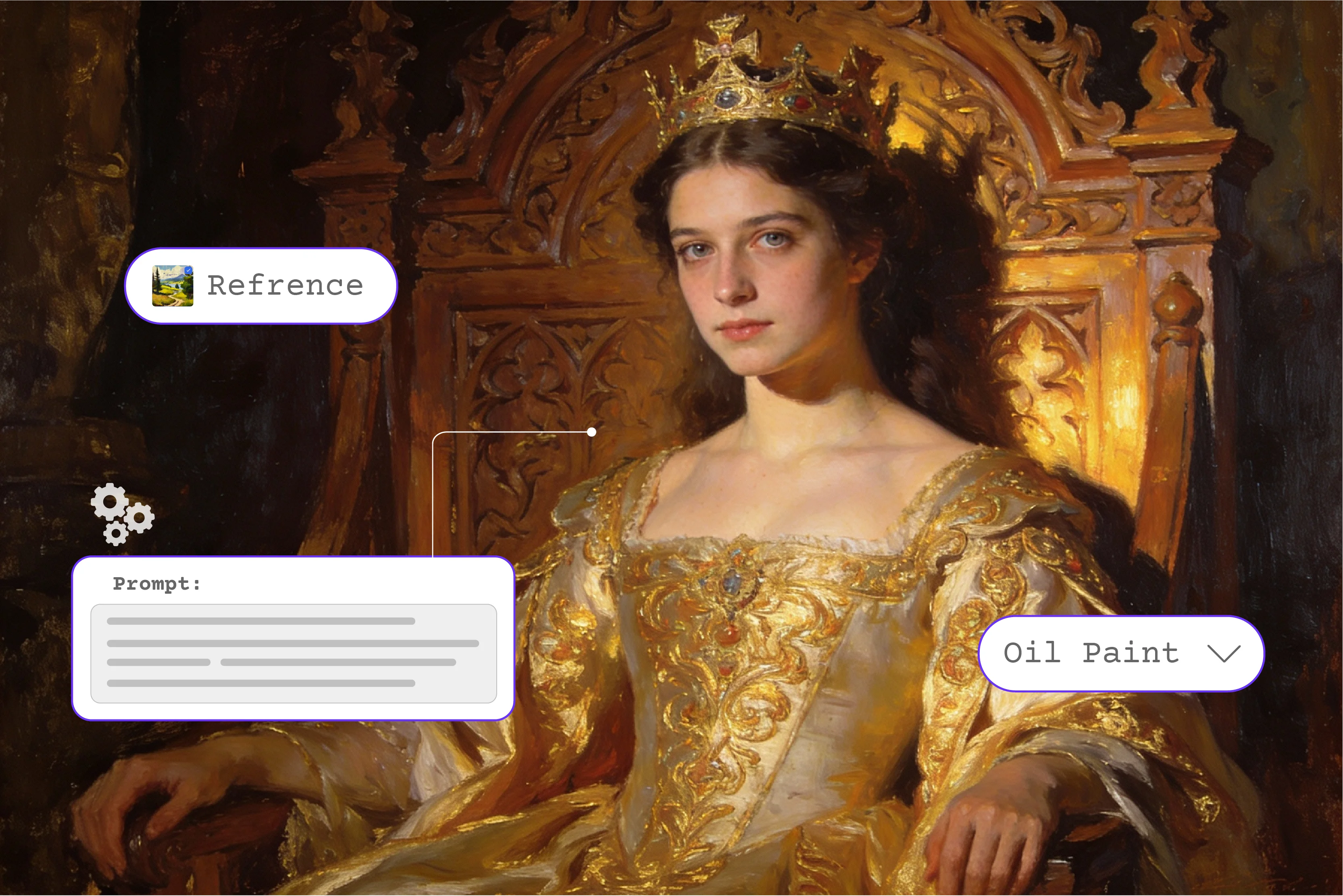
Turn your words into images in seconds with Fotor's free AI image generator. Fotor AI Image Generator offers styles like concept art, realistic cartoon sketches, oil paintings, digital art, and 3D for your AI image generation.
It’s simple to get the perfect images or create stunning visuals with our free AI image generator. Easily create various AI images for products, characters, and portraits at your fingertips, even if they don’t exist yet.
I tested one text, “Two-three girls sitting under neem trees and near blossom flowers; one girl reading a book,” to generate the result; it takes time. It provides me with options for both two girls and three girls, which is a positive result.
Faces and body parts often look strange or messed up, and even simple prompts don’t turn into images correctly. Providing various options to select the image, like classic, style template, prompt enhancer, and resolution, according to your requirements.
Key features
- Ease of use
- No watermarks
- Various styles
How to use an AI image generator using Fotor
Step 1: Visit Fotor -> AI photo -> AI image generator
Step 2: Click on the generate button; the page redirects, and enter the text that you want to enter.
Step 3: Download the result.
3. Imagine.art
Image Studio by Imagine.art is a capable free AI image generation tool with a generous daily limit and solid feature set. The only thing is that you have to describe what you want and watch the best AI image generator come up with your ideas.
It offers up to 50 free generations per day, high-quality output with no watermarks, and an all-in-one creative suite that includes tools for text-to-image generation, image editing, upscaling, and more.
I tested one text where I wrote, “A woman wearing a white dress sitting under the tree with a table and chair, a dog sitting behind, and flowers nearby.” The tool provides me with four option results.
Some outputs missed details from the prompt; for example, flowers appeared inconsistently—but overall, the tool captured the main scene well. Some users might like tools like Pixelbin or other professional-grade platforms for greater levels of customization or uniformity in detail.
Key features
- High-resolution output
- User-friendly interface
- Customizable styles
- No watermark
How to use an AI image generator using Imagine.art
Step 1: Visit Imagine.art -> Tools -> AI image generator -> explore all- > text to image.
Step 2: Enter the text that you want to generate and click on the generate button.
Step 3: Generated image.
4. Pixlr
Next on my list is Pixlr an AI-powered tool that helps you generate images from text prompts. Whether you’re crafting social media visuals, designing unique artwork or prototyping ideas.
Pixlr’s AI image tools creates images in seconds based on user provided text prompts. You simply enter your text and explore multiple customization options like adjusting lighting, composition, styles and more.
Tested one text where various options were given: square aspect, landscape, wide, with color option, no lighting, no composition, and style as required. I wrote the text “Sunset where one person is sitting near the river” with the digital art option.
I wrote the text “Sunset where one person is sitting near the river” with the digital art option.
Key features
- Ease of use
- Various styles
- Text-to-image and image-to-image
- Composition control
How to use an AI image generator using Pixlr
Step 1: Visit Pixlr -> AI image generator.
Step 2: Click on “Generate AI images.” Write the text you want and use various tools according to your requirements.
Step 3: Click on the generate button.
Step 4: Download the result.
5. Ideogram
Although the technology is advancing, generating text remains a weak spot for most diffusion-based image models, which aren’t great at drawing letters with precision. It is also best for logo design, poster design, social media graphics, product branding, and many more.
Tested text written like “Digital digital matte painting library seashell coral bookshelves warm lighting” with a 1:1 aspect ratio, no added color or style, and many more. The result was generated, but it was time-consuming.
I tried with the Ideogram free plan; with it, you are limited to 10 credits a week, and you have to wait for a few minutes before starting. While the free plan includes only basic features, I found the image quality comparable to Pixelbin, particularly when text rendering was involved.
Key features
- Multilingual text support
- Highly stylized outputs
- Text-aware generation
How to use an AI image generator using Ideogram
Step 1: Visit Ideogram
Step 2: Write a creative prompt that you want to enter.
Step 3: Click on generate and see the result.
6. Canva
With Canva AI image generators, the perfect image is always at your fingertips, even if it doesn’t exist yet. With the magic media and the image created by Dream Lab, you can quickly visualize ideas, sketch out creative concepts, and push the limits of what’s possible.
You can select the specific style and aspect ratio to match the concept you’re going for. The tool allows users to turn simple text prompts into stunning visuals in seconds. The images can be used for presentations, social media posts, and other creative projects.
Tested one text prompt like “Sunrise over snowcapped mountains, a man sitting on top”; it took time as compared to other tools. It gives four options to select from and provides other facilities to generate again if you are not satisfied with the result. Other options, like styles, squares, and more, are given according to your requirements. I tested the square option, where the output is shown in square format.
Key features
- Ease of use
- Image editing
- Text to image
- Style option
How to use an AI image generator using Canva
Step 1: Visit Canva -> click on 3 dots -> select apps and select AI image generator.
Step 2: Write the text in the text prompt that you want.
Step 3: Click on the “Generate” option and wait for a few minutes.
Step 4: See the result and download it.
Factors to consider before selecting an AI image generator
There are various challenges associated with creating images using AI, which creators and organizations must consider.
1. Technology employed
Before selecting an AI picture generator, you should first look into the technologies it uses. AI image generators use machine learning algorithms and deep neural networks to create artwork and images.
2. Ease of use
Examine the amount of work required to generate AI images. Is it easy to sign up? Does the user interface look clear and intuitive? How long does it take to create an image? Think about each of these points.
3. Displacement of creativity
As AI tools become more sophisticated, they might reduce the demand for human artists and designers, potentially leading to a loss of unique human-driven creativity. AI-generated graphics may lack the uniqueness and personal touch that human creators contribute, and the automation of creative processes may result in a uniformity of content.
4. Output quality
You should test the quality of outputs produced by an AI image generator. To select among different tools, you can provide the same prompt to each AI tool and evaluate which one produces the most attractive images that are closest to your requirements.
5. Licensing and copyright
An important aspect to consider is whether the tool is licensed to produce and distribute the image that it generates. Also, make sure that you are allowed to use the generated images on your personal and commercial projects.
AI image generation use cases
There are numerous uses of AI image generation technologies. For example, by quickly visualizing new designs, these technologies may speed up the product design process, encourage creativity in artists, and be an invaluable resource for educators.
Entertainment
In the entertainment industry, try AI image generators to create realistic environments and characters for video games and movies. This all saves time and resources that would be used to manually create these elements.
Video game developers use this AI to design detailed environments, characters, and assets, enhancing the immersive experience for players.
Content creation
The process of creating content is made smooth by AI image generation, which allows producers to develop a variety of graphics efficiently. Digital art, social media graphics, and visual narratives all benefit greatly from this technology.
Content producers can create original images that go well with their themes or narratives without having to do a lot of manual design work, which enables them to maintain a consistent style across their platform. To increase visual appeal and engagement, AI-generated graphics can also be integrated into written content.
Marketing and advertising
With AI image generators, marketers can swiftly create product photos, ad creatives, and promotional visuals that are suited to particular audiences.
This technology ensures that the best images are used in campaigns by enabling quick A/B testing and optimization, and it allows targeted advertising and promotions.
Medical imaging
In the medical field, AI models, particularly GAN-based systems, can enhance diagnostic imaging by improving resolution, reducing noise, and reconstructing missing data.
AI models can generate high-resolution images from low-quality images, assist in reconstructing 3D models from 2D images, and enhance images to highlight critical areas for diagnosis.
FAQs
AI image generation is a type of generative AI for producing visual content. It uses mathematical analysis to identify and duplicate patterns within photos and illustrations. In simpler terms, AI image generators create images based on a set of examples.
The training data for AI image generation typically comes from large-scale datasets of publicly available images collected from the internet, open-source repositories, and licensed content. These databases often include photographs, illustrations, paintings, and other visual media.
The law agrees with this view—the only creator is the AI itself developing the image, and so it is the author. An AI author cannot hold copyright; thus, AI art is ineligible for copyright registration. However, the end user is the creative, and so the end user is the author.
Be wary of perfection. Another sure-fire way of identifying an image is checking if it looks a little too perfect. AI images often lack details that can be found in real pictures, leading to these photos having an airbrushed look.
One of the first significant AI art systems was AARON, developed by Harold Cohen, beginning in the late 1960s at the University of California at San Diego.
There are various tools available, like Pixelbin, which are online and help you with the online AI image generator. You can text prompts to create and transform images quickly and easily, now with higher quality, more detail, and improved lighting and color.