
Summary
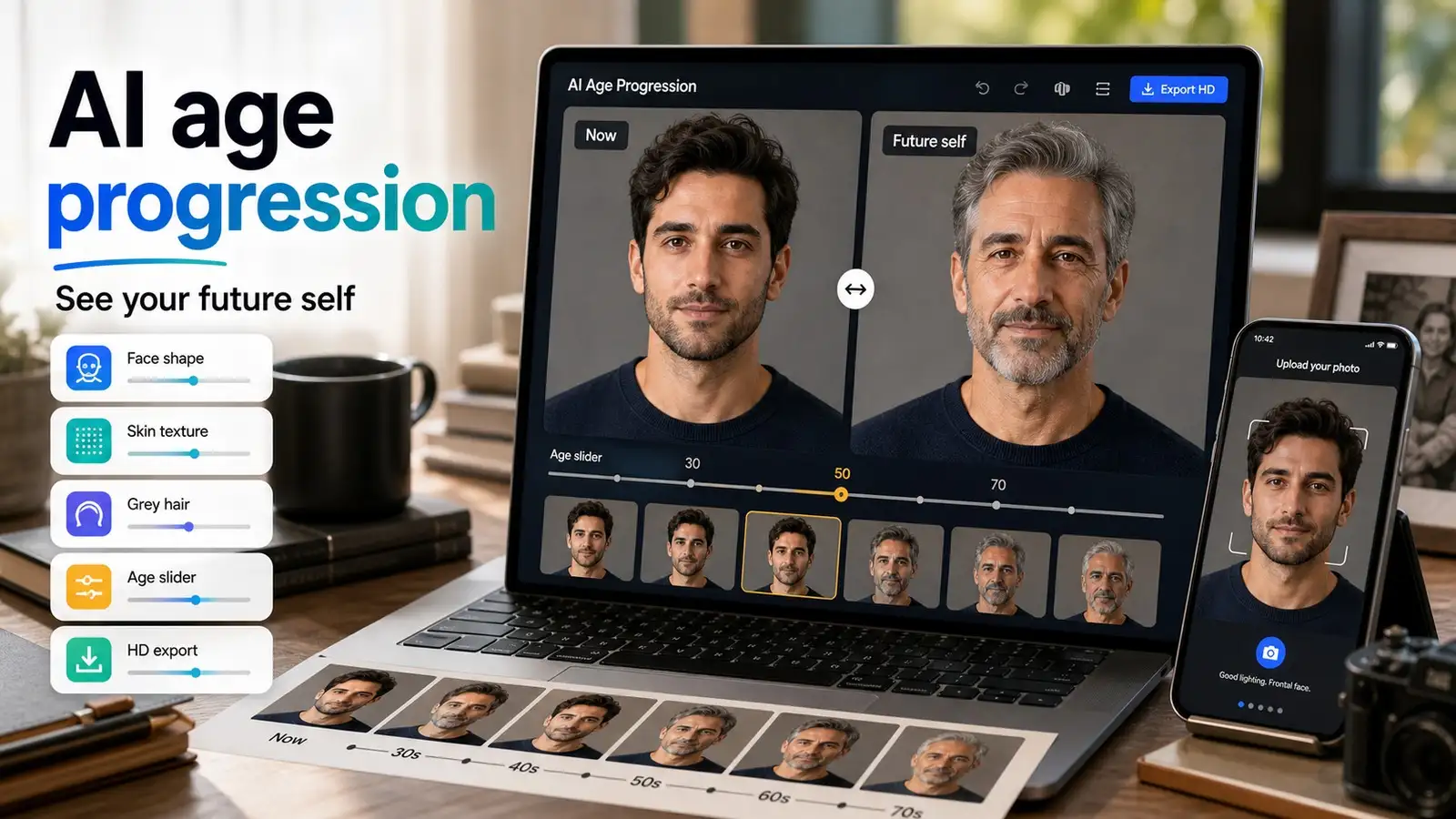
This guide explains how to create realistic AI age progression images from a photo. It covers how aging tools map face shape, skin texture, hairline, lighting, and expression, plus the best photo inputs, prompt patterns, Pixelbin workflow, and troubleshooting tips for more believable future-self previews.
Introduction
Ever wondered what you'll look like in twenty years? It's a question most people ask themselves. Whether you're curious about your aging trajectory, tracking family resemblances, or creating viral content, seeing your future face is now possible. Old apps were terrible, they'd just paste wrinkles on like clip art. Modern AI does something completely different.
Actual aging isn't superficial. Your face changes shape as gravity pulls down, collagen breaks down, and your hairline shifts. Advanced age progression tools understand this. They map your specific facial structure and simulate exactly how those changes will unfold for you personally, not some generic template.
This guide teaches you to use age progression tool like Pixelbin AI age progression photo generator, explain what makes them accurate and more.
How to age a face in under a minute
If you are looking for the fastest, most effective way to see your future self right now, the process has been distilled into a simple digital workflow. You no longer need to download heavy, ad-ridden applications or buy expensive desktop software to experiment with free age progression online.
A reliable, modern workflow follows these exact execution steps:
- Upload a Clear Portrait: Start with a well-lit, high-resolution photograph where your face is completely visible and facing forward.
- Select Your Target Age: Decide on the specific life stage you want to preview, such as young adult, middle age, or a senior look.
- Write a Specific Prompt: Give the AI contextual clues about lifestyle, environment, or specific genetic traits (like graying hair or fine lines) to guide the rendering engine.
- Generate and Analyze: Run the model and use a side-by-side or slider view to compare your original image against the new output.
- Refine and Download: If certain details feel off, tweak your text instructions slightly and regenerate until you achieve an uncompressed, watermark-free HD export.
What makes an age progression image look truly realistic?
When an ageing effect looks fake, your brain flags it instantly. We interact with human faces every day, making us subconscious experts at detecting unnatural facial shifts. To achieve a believable result with an AI age progression free tool, the underlying model must master five core biological and environmental elements simultaneously.
Face shape consistency
As humans age, our underlying skeletal structure and soft tissues shift. Cartilage in the nose and ears continues to grow slowly throughout our lives, while the jawline loses some of its youthful, sharp definition due to skin elasticity changes. A top-tier age progression ai maps these specific anatomical shifts, gently adjusting the lower face rather than just expanding the outer borders of the head. It ensures your core identity remains completely recognizable.
Skin texture and elasticity changes
Realistic ageing requires a sophisticated understanding of dermatological layers. True age progression introduces micro-details like:
- Fine lines around the corners of the eyes (crow's feet)
- Deepening nasolabial folds (the lines running from the nose to the mouth)
- Subtle sun spots, hyperpigmentation, and natural skin pore expansion
The AI must embed these elements into the skin's texture rather than stamping them on top, allowing light and shadow to interact with the wrinkles naturally.
Hair color, density, and hairline shifts
Hair undergoes one of the most visible transformations over time. A realistic age progression app, a free tool, will not just spray a solid coat of white paint over your head. Instead, it simulates natural greying patterns, typically starting at the temples before spreading inward. Furthermore, it accounts for changes in density, subtly thinning the volume or shifting the hairline backwards to mimic standard genetic ageing patterns for both men and women.
Expression retention
Your identity is heavily tied to how your face moves. If you upload a photo with a warm smile, the aged output must preserve the exact positioning of your eyes, the curl of your lips, and the unique geometry of your expression. If the algorithm alters your underlying expression, the final image will look like an entirely different person. The best tools isolate ageing traits and apply them directly over your natural resting or active facial muscles.
Lighting and environmental consistency
A major flaw in primitive filters is that the aged sections of the face often feature different lighting than the original background. Advanced models analyze the global illumination of your photo. If light is hitting your cheek from the left side, every newly generated wrinkle, skin fold, and gray hair strand on that side will cast a mathematically accurate shadow toward the right, blending the face perfectly into its original environment.
Select the best photos for flawless AI analysis
An artificial intelligence model is entirely dependent on the quality of the data it receives. If you feed an age progression tool a low-quality, heavily compressed image, the algorithm will be forced to guess your facial structure, which leads to distorted, plastic-looking results.
To achieve professional-grade results, select a source photo that matches the following criteria:
Master the best prompt patterns for age customization
While quick buttons and presets are incredibly convenient, entering descriptive custom text prompts allows you to control the exact narrative of your future look. Whether you are using an app to determine your right ai age or trying out a female face age progression, tailoring your text inputs helps the model understand your creative goals.
Here are highly effective, field-tested prompt patterns you can copy and paste into your next generation session:
Visualizing your future self (ages 30 to 80+)
- For Middle Age (40s-50s): "A realistic portrait of a 45-year-old version of this person, subtle laugh lines around the eyes, faint silver strands appearing naturally at the temples, professional setting, sharp focus, natural skin texture."
- For Senior Years (60s-70s): "An elegant, detailed photograph of this individual in their late 60s, natural gray hair with realistic volume, soft wrinkles across the forehead and cheeks, warm and authentic expression, soft studio lighting."
- For Advanced Age (80s+): "A deeply detailed, cinematic macro portrait of this person at age 85, wisdom lines, completely white hair, soft and highly detailed skin texture showing natural aging, gentle and kind eyes, realistic depth of field."
Reversing the clock: seeing your younger self
- To Young Adult: "A crisp, clean photograph reversing this person's age back to a vibrant 22-year-old, smooth skin texture, full hair volume with original deep color, bright and clear eyes, natural daylight."
- To Teenage Years: "A nostalgic, clear photo of this individual as a 16-year-old teenager, youthful facial structure, smooth skin, casual and relaxed expression, high-resolution portrait."
Tracking growth: child-to-adult previews
- The "Age My Child" Prediction: "A realistic lifestyle portrait predicting how this child will look as a 25-year-old adult, maintaining the exact eye shape, nose structure, and natural smile, sharp focus, contemporary professional attire."
Author’s tip: What to Avoid Writing: Never include vague, subjective buzzwords like "photorealistic," "4K resolution," or "hyper-detailed." These phrases confuse the model's text-parsing engine. Instead, focus heavily on concrete nouns and physical descriptions like "natural skin pores," "silver temples," "fine lines," or "soft daylight."
How to generate age progression photos with Pixelbin?
The Pixelbin AI Age Progression Tool delivers an unmatched generative experience for anyone curious about the future. Moving away from gimmicky apps that merely stamp low-quality wrinkles onto your skin, Pixelbin uses advanced neural networks to evaluate your unique facial anatomy.
The tool carefully calculates how your specific bone structure, skin elasticity, and hairline will naturally transition over twenty, forty, or sixty years. This web-based platform serves as an accurate digital time machine, letting you discover structural shifts while keeping your core identity intact. It is efficient, intuitive, and offers premium age-mapping without forced sign-up blocks.
Step 1: upload your source image
Open your browser and navigate to Pixelbin’s dedicated tool. Drop your file directly into the upload box or paste a direct image URL. The platform natively accepts all popular web formats, including JPG, JPEG, PNG, and WEBP, with support for file sizes up to 10MB.
Step 2: choose a quick preset or add your custom prompt
Depending on your goals, you can click on instant age filters like Teen, Young Adult, or Middle Age to adjust the timeline with a single click. If you want a specific milestone like seeing exactly how you will look at 75, type your custom parameters into the prompt box using the patterns we outlined above.
Step 3: select your ideal AI image model
Pixelbin puts creative power in your hands by offering distinct processing tiers. You can choose Nano Banana for rapid, lightweight generation previews Pixelbin , or step up to the Pro model when you need ultra-sharp details, intricate skin textures, and maximum realism for personal archiving or professional use.
Step 4: configure the aspect ratio
Tailor your output to match exactly where you plan to share or store it. The tool features built-in aspect ratios optimized for various platforms:
- Square (1:1): Perfect for clean Instagram grid posts and profile avatars.
- Vertical (4:5 or 9:16): Ideal for smartphone wallpapers, TikTok transitions, and mobile Stories.
- Wide (16:9): Excellent for presentations, desktop mockups, or family video montages.
Step 5: Generate and Download Your HD Masterpiece
Click the generate button and watch the model process your traits in real time. Once the preview appears, evaluate the details. You can download your aged image instantly in high-definition quality, completely free of watermarks, hidden paywalls, text labels, or distracting corporate logos.
Common mistakes and how to fix them
If your initial attempt at generating an aged face looks a bit unusual, do not worry. Minor issues are almost always caused by a mismatch between the source photo and the AI's expectations. Use this quick troubleshooting guide to fix your generations instantly:
Photo angle changes your true identity
- The Problem: The generated older face looks completely unrecognizable or takes on features that do not belong to you.
- The Cause: You uploaded a photo taken from a dramatic high or low angle, or your head is turned to the side.
- The Fix: Swap the photo out for a straight-on, eye-level portrait. The more symmetrical the input, the better the AI can preserve your core genetic markers.
Low light creates "plastic" or blurry skin
- The Problem: The aged skin looks like smooth plastic, or the wrinkles look like muddy smudge marks on your face.
- The Cause: The original image was captured in a dark room or suffered from heavy digital noise and compression.
- The Fix: Use a high-quality photo shot in clear, bright daylight. If your favorite photo is a bit blurry, run it through an AI image upscaler before running the age progression filter.
Vague prompts produce a generic, cliched face
- The Problem: The output looks like a stock photo of an elderly person rather than a believable, older version of you.
- The Cause: Your prompt was too simple, like "make me old" or "aged person." This forces the AI to pull from generic training data.
- The Fix: Make your prompt hyper-specific to your face. Mention that it must maintain your exact eye shape, expression, and jawline structure while only adding age-appropriate skin and hair texture.
Group photos confuse the generation engine
- The Problem: The AI applies the aging effect to the wrong person in the picture, or merges multiple faces into a strange hybrid look.
- The Cause: There are multiple human faces present within a single upload frame.
- The Fix: Use a cropping tool to isolate your face entirely before uploading, ensuring you are the sole focal point of the image file.
Conclusion
There is no need to keep guessing how the passing years will shape your appearance or rewrite your style. Visualizing the future is no longer a matter of imagination; it is a matter of clicking a button.
Experience the power of advanced generational mapping firsthand. Visit the Pixelbin AI Age Progression Tool right now, take advantage of your free monthly credits, and discover a stunningly realistic look at your future self in seconds.
FAQs
The most reliable method is to use a dedicated online age progression platform. By uploading a high-resolution portrait, the system uses deep learning to calculate changes in your skin elasticity, hair color, and facial structure, giving you a highly accurate glimpse into your future look.
Yes, Pixelbin provides a highly accessible free ai age progression tool directly inside your web browser. You can transform up to three images every single month entirely for free, allowing you to test out different ages and styles without any financial commitment.
Absolutely. Pixelbin allows users to jump straight into the editor, upload their favorite photos, choose an age setting, and generate results instantly without entering an email address, setting up a password, or inputting any payment details.
Yes! By uploading a clear, front-facing photo of a toddler or child, you can use a custom prompt like "predict how this child will look as a 25-year-old adult" to map out their growing features. This provides a fascinating, realistic look at future family resemblances.
Yes, the underlying model is trained on diverse datasets containing thousands of faces across all genders. It accurately processes a female face age progression by focusing on elegant aging lines and volume adjustments, just as it handles male structural changes like receding hairlines or silver beard textures.
The platform is designed to be highly flexible, fully supporting standard web formats including JPG, JPEG, PNG, and WEBP. To ensure smooth processing and fast render times, make sure your uploaded image file stays under the 10MB limit.