
Summary
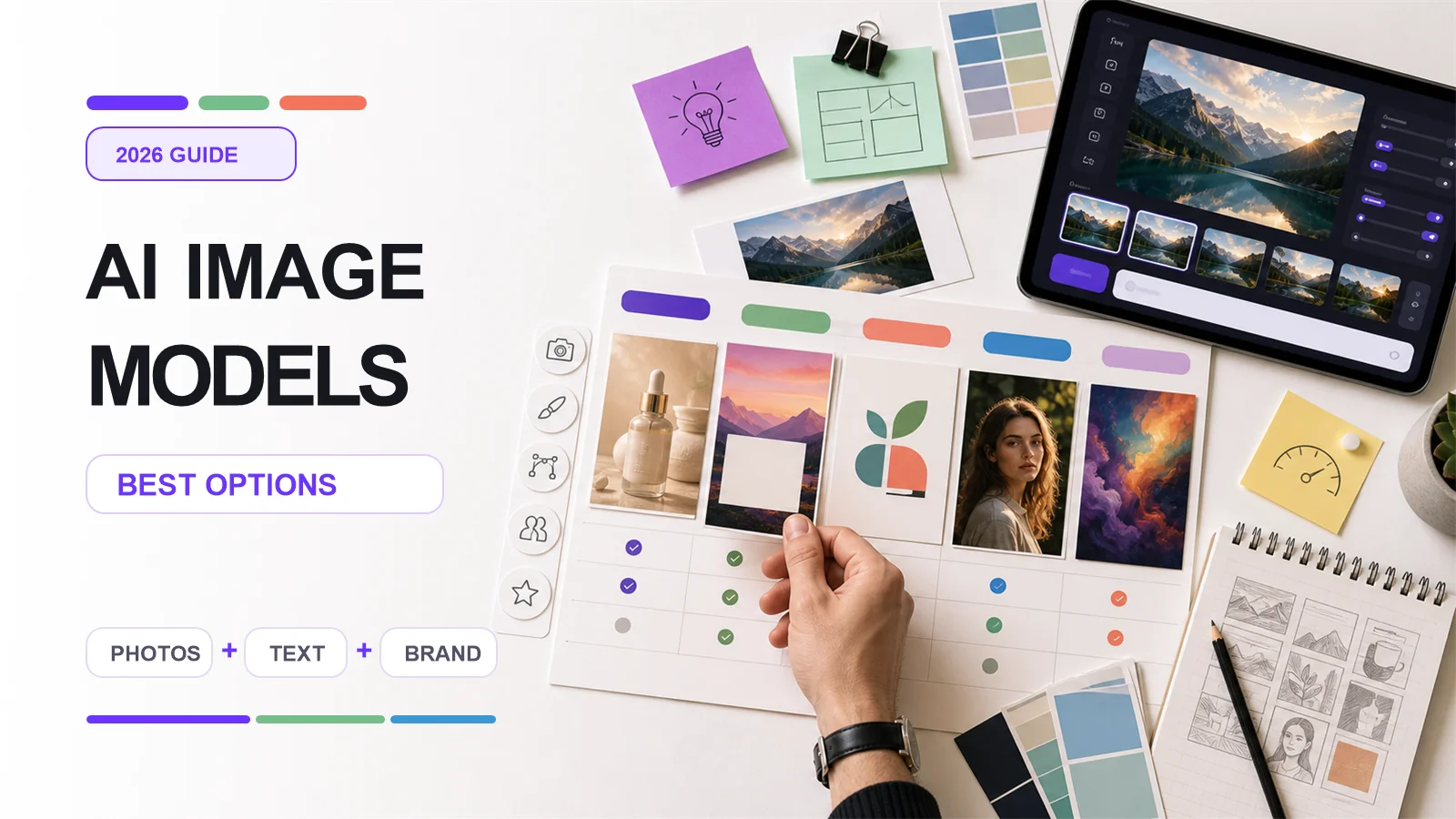
AI image models are now useful for real work like blog graphics, ads, product mockups, thumbnails, posters, logos, and brand design. This guide compares the best models by use case, including photos, text, brand graphics, commercial-safe work, and custom workflows, so users can choose the right model without wasting time or credits.
Introduction
AI image models are now good enough for real work: blog graphics, product mockups, ad concepts, social posts, thumbnails, storyboards, posters, logos, and design drafts. The hard part is no longer finding a tool. The hard part is choosing the right model for the job.
Some AI image models are better at realistic photos. Some are better at readable text. Some are better for brand graphics. Some give developers more control. Some are safer for commercial work. If you pick only by popularity, you may end up with beautiful images that do not fit your actual use case.
This guide explains what AI image models are, how they work in simple terms, which models are worth knowing in 2026, and how to choose one without wasting time or credits
Quick Answer: What Are AI Image Models?
AI image models are systems that create or edit images from text prompts, reference images, sketches, or design instructions. You describe what you want, and the model returns a new image or changes an existing one
For most people, the best AI image model depends on the task:
- For everyday image generation: ChatGPT Images / OpenAI GPT Image models
- For Google users and fast editing: Gemini image generation and Imagen
- For artistic visuals: Midjourney
- For readable text inside images: Ideogram
- For brand graphics and vectors: Recraft
- For commercial-safe creative work: Adobe Firefly
- For open-source and custom workflows: FLUX and Stable Diffusion
What Is An AI Image Model?
At its core, an AI image model is the mathematical machine or "brain" that translates human language into visual pixels.
To understand how it works, it helps to separate the interface you use from the model running behind the scenes:
- The Interface : This is the app, website, or chat window where you type your prompt (like ChatGPT, Google Gemini, or Photoshop). It handles the user experience, remembers your chat history, and gives you buttons to crop or download the file.
- The Model : This is the actual AI network running on powerful cloud servers. It takes your words, analyzes what they mean visually, and physically constructs the image from scratch.
For example, when you use ChatGPT to create an image, ChatGPT is the interface, but DALL-E 3 is the underlying image model doing the heavy lifting.
How it Actually Works (Beginner’s guide)
An AI image model is trained on billions of images paired with text descriptions. Through this training, it learns concepts. It doesn't just copy and paste pieces of existing photos; instead, it learns what a "stainless steel water bottle," "morning light," and "photorealism" actually look like.
When you give it a text prompt, the model goes through a process called diffusion:
- It starts with a canvas of complete, random visual static (like digital television snow).
- It looks at your prompt and slowly, over a series of steps, begins to rearrange those random pixels to form shapes.
- It refines those shapes until they match your description, turning the static into a crisp, high-resolution image.
What Makes a Good Model?
In a professional workflow, a model shouldn't just be judged by how "pretty" its images are. A truly powerful image model is evaluated on five human-centric capabilities:
- Prompt Adherence: Does it actually follow all your instructions, or does it ignore half of your text?
- Anatomical Realism: Can it draw human hands, faces, and limbs without bizarre distortions?
- Text Rendering: Can it cleanly spell out specific words inside the image (like on a storefront or product label) without turning them into gibberish?
- Style Consistency: Can it generate multiple different images that all share the exact same color palette, line weight, or brand aesthetic?
- Compositional Control: Can you easily tell it where to place specific objects on the canvas, or does it just throw them anywhere?
Ultimately, different models are tuned for different strengths. Some are built like master painters (Midjourney), some are built like hyper-precise graphic designers (Recraft), and others are built to be flexible conversational partners (OpenAI's image engines).
Best AI Image Models In 2026
1. ChatGPT Images / OpenAI GPT Image | Best For Everyday Images
Integrated directly into ChatGPT, OpenAI’s image ecosystem relies on DALL-E 3, one of the best AI image generators for absolute beginner-friendliness and precision.
Key Feature (Prompt Expansion): Unlike other text to image models that require complex engineering, DALL-E uses ChatGPT to automatically expand short user prompts into highly descriptive instructions, ensuring a close match to your intent.
Capabilities & Limitations: It excels at rendering text inside images, maintaining strict prompt adherence, and producing vibrant, clean illustrations. However, it can struggle with raw photographic realism compared to specialized artistic models and enforces strict safety guardrails.
Best For: Seamless workflow integration inside ChatGPT, precise text rendering, and highly descriptive prompt compliance.
2. Imagen And Gemini Image Generation | Best For Google Users
Integrated directly into ChatGPT, OpenAI’s image ecosystem relies on DALL-E 3, one of the best AI image generators for absolute beginner-friendliness and precision.
Key Feature (Prompt Expansion): Unlike other text to image models that require complex engineering, DALL-E uses ChatGPT to automatically expand short user prompts into highly descriptive instructions, ensuring a close match to your intent.
Capabilities & Limitations: It excels at rendering text inside images, maintaining strict prompt adherence, and producing vibrant, clean illustrations. However, it can struggle with raw photographic realism compared to specialized artistic models and enforces strict safety guardrails.
Best For: Seamless workflow integration inside ChatGPT, precise text rendering, and highly descriptive prompt compliance.
3. Midjourney | Best For Artistic Visuals
Widely considered one of the best AI image models for pure artistic execution, Midjourney operates primarily through Discord and a dedicated web interface.
Key Feature (Artistic Aesthetic): Midjourney has a distinct, built-in cinematic and painterly style that makes even simple prompts look like highly produced digital art or professional photography.
Capabilities & Limitations: It offers robust advanced controls like image weights (--iw), aspect ratio adjustments (--ar), style tuning, and consistent character creation. The primary drawback is its steep learning curve and reliance on a prompt structure that is less conversational than competitor models.
Best For: High-end commercial art, stunning cinematic photorealism, and complex stylistic control.
4. Ideogram | Best For Text Inside Images
Ideogram is a specialized text-to-image generator that carved out a massive niche by mastering a major pain point for early AI image models: typography.
Key Feature (Flawless Text Rendering): It is arguably the most reliable model for generating clear, beautifully styled, and accurate text embedded within complex graphics.
Capabilities & Limitations: It is incredibly efficient for designing posters, logos, t-shirt prints, and book covers. While its general artistic and photorealistic capabilities are strong, its primary competitive edge remains its typographic accuracy.
Best For: Graphic design, branding materials, and any visual requiring precise typography.
5. Adobe Firefly | Best For Commercial-Safe Creative Work
Built from the ground up for creative professionals, Adobe Firefly powers generative AI features inside Photoshop, Illustrator, and a standalone web app.
Key Feature (Commercial Safety): Firefly is unique among AI image generator models because it is trained exclusively on licensed content, such as Adobe Stock, and public domain images, making it legally safe for commercial enterprise use.
Capabilities & Limitations: It features unmatched deep integration with professional design workflows (Generative Fill, Generative Expand, and Text-to-Vector). It focuses heavily on commercial utility rather than hyper-stylized abstract art.
Best For: Professional graphic designers, enterprise marketing, and lawful commercial use.
6. FLUX | Best For Developers And Custom Workflows
Developed by the original creators of Stable Diffusion, FLUX is a powerhouse in the open-weights community and one of the most advanced text to image models available.
Key Feature (Hybrid Precision): Available in various tiers (including Pro, Dev, and Schnell), FLUX combines the prompt adherence and text rendering of DALL-E with the exceptional hyper-realism and anatomy mapping of Midjourney.
Capabilities & Limitations: It handles difficult details like human hands, complex eyes, and structural text perfectly. While the base models are open-weights and highly customizable, running the highest-tier models locally requires substantial computational power (high VRAM).
Best For: Hyper-realistic human anatomy, open-weights customization, and state-of-the-art detail.
7. Stable Diffusion | Best Open-Source Option
The bedrock of the open-source AI art movement, Stable Diffusion (spanning from SD 1.5 and SDXL to the latest SD3 architectures) allows users to run models entirely on their own hardware.
Key Feature (Absolute Customization): Unlike closed ecosystems, Stable Diffusion allows the integration of custom-trained checkpoints, LoRAs (Style modifiers), ControlNet (fine-grained pose and structure control), and complex inpainting interfaces.
Capabilities & Limitations: It offers infinite freedom and flexibility, allowing you to fine-tune the model on any specific style or object. However, it requires a powerful dedicated graphics card and significant technical setup compared to cloud-based tools.
Best For: Local generation, fine-grained control over composition/poses, and complete open-source flexibility.
8. Best For Brand Graphics And Vectors: Recraft
A design-centric tool that differentiates itself from standard AI image generation models by focusing on structured graphic assets rather than just flat raster illustrations.
Key Feature (Infinite Vector Generation): Recraft stands out for its unique ability to generate true vector graphics (SVG files) that can be infinitely scaled without losing quality, alongside high-quality raster styles.
Capabilities & Limitations: It offers granular control over style consistency, brand color palettes, and specific design outputs like line art, 3D icons, and seamless patterns. It is a tool built strictly around the needs of UI/UX designers and digital illustrators rather than generic art enthusiasts.
Best For: Scalable vector illustrations, UI icons, icon sets, and brand-consistent design elements.
How To Choose The Right AI Image Model
Use this simple decision path:
1. Need realistic photos?
Try OpenAI GPT Image, Google Imagen, Gemini image generation, FLUX, or Midjourney.
2. Need text inside the image?
Try Ideogram first. Also test GPT Image and Imagen for short text.
3. Need brand graphics, icons, or vectors?
Try Recraft or Adobe Firefly.
4. Need social media speed?
Try ChatGPT Images, Canva, Adobe Express, or Leonardo AI.
5. Need commercial-safe assets for a company?
Check Adobe Firefly, your model's terms, and any indemnity offered by your plan.
6. Need local control or custom styles?
Try Stable Diffusion or FLUX workflows.
7. Need artistic images with a strong mood?
Try Midjourney.
The best test is simple: give three models the same prompt, compare the results, and count how many edits each one needs before the image is usable.
A Simple 5-Prompt Test Before You Pick A Model
Before paying for a tool, run these five prompts:
Prompt 1: Product Photo
"A realistic product photo of a matte black reusable coffee cup on a wooden desk, soft morning light, clean background, no text."
What to check: Realism, lighting, object shape, shadows, and whether the cup looks usable.
Prompt 2: Text Graphic
"Create a square poster with the text 'Fresh Start' in clean bold lettering, soft green background, minimal design."
What to check: Spelling, letter shape, layout, and whether the text is readable on mobile.
Prompt 3: Human Scene
"A realistic lifestyle photo of a small business owner packing handmade candles at a bright studio table."
What to check: Hands, face, lighting, object details, and whether the scene feels natural.
Prompt 4: Brand Style
"Create three matching social media graphics for an eco-friendly skincare brand, calm colors, simple layout, premium but friendly."
What to check: Style consistency, color control, and whether the outputs feel like one brand.
Prompt 5: Editing Task
Upload an image and ask:
"Remove the background clutter and make the scene look clean, but keep the product unchanged."
What to check: Whether the product stays accurate and the edit looks natural.
If a model passes these five tests, it is probably good enough for regular use.
Common Mistakes To Avoid
Mistake 1: Choosing The Most Popular Model Only
Popularity helps, but it does not guarantee the right output. A model that creates amazing art may still be weak for readable labels or brand-safe work.
Mistake 2: Ignoring Image Rights
Before using any generated image in ads, packaging, client work, or paid campaigns, check the tool's terms. Look for commercial-use rights, watermark rules, and whether your plan offers extra protection.
Mistake 3: Publishing Without Human Review
Always check hands, faces, product details, text, logos, and background objects. Small errors can make a brand look careless
Mistake 4: Using One Prompt And Giving Up
Image generation is often an editing process. The first image is a draft. The second or third version is usually closer to what you can use.
Mistake 5: Forgetting Brand Consistency
If every image has a different style, your website or social feed can look messy. Use brand colors, fixed style notes, reference images, and saved prompt templates.
Are AI Image Models Safe For Commercial Use?
Sometimes, but not always.
Commercial use depends on the model, the product, your subscription plan, and the terms of service. Adobe Firefly is often chosen by businesses because Adobe positions it around commercially safe creative work. Other tools may also allow commercial use, but you should still read the terms before using images in paid campaigns, packaging, merchandise, or client deliverables.
Also remember:
- Do not generate images that copy a living artist's exact style for commercial work.
- Do not use brand logos unless you have rights.
- Do not create fake product claims.
- Do not use AI-generated people in a misleading way.
- Keep records of prompts, dates, and tools used for important projects.
For serious brand work, treat AI images like stock photos: useful, but still something you need to review legally and creatively.
Best AI Image Models By Use Case
For Blog Images
Use ChatGPT Images, Gemini, Midjourney, or Adobe Firefly. Keep images simple, relevant, and not too generic. Add original screenshots when possible.
For Product Mockups
Use GPT Image, Imagen, FLUX, Recraft, or Firefly. Check shape accuracy and do not let the model change the product.
For Ads
Use Ideogram for text-heavy ads, Firefly for Adobe workflows, Recraft for brand graphics, and ChatGPT Images for quick concepts.
For Logos
Use Recraft or Ideogram for concepting, but do not publish a logo without a designer cleaning it up and checking trademark risk.
For YouTube Thumbnails
Use Ideogram if text is part of the thumbnail. Use Midjourney or ChatGPT Images if the visual emotion matters more than typography.
For App Or Website Graphics
Use Recraft for icons and vectors. Use Firefly or ChatGPT Images for illustrations. Use Stable Diffusion or FLUX if your team needs custom style control.
For Private Or Local Work
Use Stable Diffusion or other local/open workflows if privacy is the main concern. Check hardware needs before committing.
Final Recommendation
If you are new to AI image models, start with two tools instead of ten:
- One general image model for everyday work.
- One specialist model for your main weak point, such as text, vectors, or commercial-safe editing.
For many teams, that means ChatGPT Images plus either Ideogram, Firefly, Recraft, or Midjourney. If you are a developer or technical creator, test FLUX and Stable Diffusion too.
The best AI image model is not the one with the loudest hype. It is the one that gives you a useful image, in your style, with fewer fixes.
FAQs
AI image models are systems that create or edit images from text prompts, reference images, sketches, or uploaded photos. They power tools like ChatGPT Images, Midjourney, Adobe Firefly, Ideogram, Recraft, and Gemini image generation.
There is no single best AI image model for every user. ChatGPT Images is strong for general use, Midjourney is strong for artistic visuals, Ideogram is strong for text inside images, Adobe Firefly is strong for commercial-safe creative workflows, and FLUX or Stable Diffusion are strong for custom technical workflows.
Ideogram is one of the best-known choices for text inside images. It is useful for posters, thumbnails, labels, and simple logo concepts. Still, you should check every word before publishing.
For business use, check Adobe Firefly, OpenAI GPT Image models, Google Imagen/Gemini image generation, Recraft, and Ideogram. The right choice depends on whether you need commercial safety, readable text, brand graphics, product images, or editing.
Often yes, but it depends on the tool, model, plan, and terms of service. Always check commercial-use rules before using AI-generated images in ads, client work, packaging, merchandise, or paid campaigns.
They are better for custom concepts, unusual scenes, and fast drafts. Stock photos can still be better when you need real people, verified locations, legal clarity, or editorial accuracy.